Saudi Arabia has nine business schools with international accreditation. It has none with the triple crown, one with an internationally accredited MBA, and a national university that ranks first in the entire Arab world.
This guide ranks the country’s business schools on evidence you can check rather than on adjectives. Every accreditation below was verified against the accrediting body’s own directory, and every fee comes from the university’s own published schedule.
Studying Business in Saudi Arabia? Get Assignment Help From Qualified Tutors
How This Ranking Works
Most “best business schools” lists are opinion dressed as research. This one uses three checkable inputs, in this order.
| Criterion | Why it comes first | Where it is verified |
| International accreditation | AACSB, EQUIS and AMBA assess the school itself — its faculty, curriculum and assurance of learning. It is the hardest thing on this list to fake | AACSB, EFMD and AMBA public directories |
| Ranking position | QS assesses the university, not the business school, but it is the best comparable measure available | QS Arab Region 2026 and QS World 2027 |
| Programme-level recognition | A school whose MBA is separately accredited or ranked has been assessed on the programme you would actually take | AMBA and QS Global MBA Rankings |
Fees are reported but not ranked. A more expensive MBA is not a better one, and the spread in Saudi Arabia is wide enough that price tells you more about positioning than quality.
The Accreditation Landscape, in One Minute
Before the list, the context that makes it readable.
| Accreditation | Saudi schools holding it | What it means |
| AACSB | 9 (per AACSB’s own country filter) | The most widely held international business accreditation. Roughly 6% of business schools worldwide have it |
| AMBA | 1 — KFUPM Business School, since January 2025 | Accredits the MBA programme specifically rather than the school |
| EQUIS | 0 | No Saudi business school holds EQUIS. Two UAE schools do, both outside Dubai |
| Triple crown | 0 | No Saudi school holds all three. KFUPM is the only double-accredited school |
| EFMD programme accreditation | 1 — a single BSc Finance at the University of Business and Technology | Programme-level, not institutional |
A distinction worth knowing before anyone sells it to you. BGA membership is not BGA accreditation. Two Saudi schools are BGA members; none appears on BGA’s accredited list. Membership is a paid network subscription. If a prospectus leads with it, read the word carefully.
The Nine Schools at a Glance
The whole ranking in one table. Detail on each follows.
| # | Business school | City | Accreditation | QS Arab 2026 | MBA fee |
| 1 | KFUPM Business School | Dhahran | AACSB + AMBA | #1 | SAR 33,600–80,000 |
| 2 | King Saud University — CBA | Riyadh | AACSB | #4 | Not published |
| 3 | King Abdulaziz University — FEA | Jeddah | AACSB | #7 | Not published |
| 4 | Prince Sultan University — CBA | Riyadh | AACSB × 2 (Business + Accounting) | Ranked | SAR 5,000/credit |
| 5 | Prince Mohammad Bin Fahd University | Al Khobar | AACSB | #18 | SAR 65,000–80,000 |
| 6 | Alfaisal University — College of Business | Riyadh | AACSB (July 2026) | Ranked | SAR 200,000 |
| 7 | King Faisal University | Al-Ahsa | AACSB (April 2025) | #26 | Not published |
| 8 | Qassim University — CBE | Buraydah | AACSB | #48 | Not published |
| 9 | University of Business and Technology | Jeddah | EFMD programme | Not ranked | SAR 140,016 |
“Ranked” means the university appears in the QS Arab Region 2026 list but outside the top twelve Saudi entries, for which QS publishes the exact position only to registered users.
What AACSB Accreditation Actually Involves
The word gets used loosely in prospectuses, so it is worth knowing what sits behind it before you weigh it.
AACSB assesses the school rather than any single degree. It looks at faculty qualifications and how many hold doctorates, at curriculum design, at what the school can demonstrate about student learning outcomes, and at whether the school does what its own mission says it does.
The process typically takes years, involves a peer-review team visiting the campus, and is reaffirmed on a cycle rather than granted permanently. KFUPM, accredited in 2003, has been reaffirmed three times — in 2013, 2018 and 2023.
Roughly six per cent of business schools worldwide hold it. Two things follow from that. A Saudi school with AACSB has cleared a genuinely high bar. And a Saudi school without it is not thereby bad — most business schools anywhere in the world do not have it, and several Saudi schools without it are well regarded nationally.
What to watch for. Accreditation belongs to a named school within a university, not to the university as a whole. “King Saud University is AACSB-accredited” is shorthand for “King Saud University’s College of Business Administration is AACSB-accredited”. If you are applying to a different college at the same university, the accreditation does not travel with you.
1. KFUPM Business School — King Fahd University of Petroleum and Minerals
Dhahran · AACSB since 2003 · AMBA since January 2025 · QS Arab Region #1 · QS World #63
KFUPM is not just the strongest business school in Saudi Arabia. Its parent university is ranked first in the entire Arab region and 63rd in the world, and KFUPM says it is the only Arab university in the global top 100 for a second consecutive year.
The business school earned AMBA accreditation for its MBA in January 2025, making it the only AMBA-accredited programme in the Kingdom. It has held AACSB since 2003, reaffirmed three times.
It is also the only Saudi business school that appears in global business-school rankings: #131–140 in the QS Global MBA Rankings 2026, #121–130 in the QS Executive MBA Rankings 2026, and #23 in the world for Supply Chain Management in the QS Business Masters rankings 2025.
The MBA runs part-time over two years, taught in English on weekday evenings from 17:20 to 21:25 — built for people already working. The list fee is SAR 80,000, with a discounted rate published as low as SAR 33,600. Employer-sponsored candidates from the private sector pay SAR 150,000.
2. King Saud University — College of Business Administration
Riyadh · AACSB · QS Arab Region #4 · QS World #107
The second-ranked university in the Arab region and the second-highest placed Saudi institution in the world rankings. Its College of Business Administration is AACSB-accredited.
The MBA is 48 credit hours — 39 core plus 9 in a major — completed over a minimum of five and a maximum of ten semesters, combining coursework with a research project. Teaching is in English, and entry requires TOEFL 61 iBT or IELTS 6.
KSU does not publish an MBA fee on its programme page. You will need to ask admissions directly.
3. King Abdulaziz University — Faculty of Economics and Administration
Jeddah · AACSB · QS Arab Region #7 · QS World #200
The largest of the three by enrolment and the only Saudi university sitting exactly on the Vision 2030 threshold, at 200 in the world.
The Faculty of Economics and Administration is AACSB-accredited and its MBA is professionally oriented, taught in English over two years. Like KSU, it publishes no fee on the programme page.
4. Prince Sultan University — College of Business Administration
**Riyadh · AACSB in Business *and* Accounting**
One of only a handful of schools in the region holding AACSB’s separate accounting accreditation alongside the business one. If accounting is your field, that second accreditation is a genuine differentiator and most lists never mention it.
The MBA runs in four tracks — General, Finance, Human Resource Management and Marketing — at SAR 5,000 per credit hour. The credit-hour count is not published, so ask for the total before you compare it with anything else on this page.
5. Prince Mohammad Bin Fahd University — College of Business Administration
Al Khobar · AACSB · QS Arab Region #18 · QS World #421
A private university in the Eastern Province with an AACSB-accredited business college and the clearest fee structure of any school here.
The MBA is 36 credit hours. From the 2025/26 academic year the fee is SAR 80,000 for external candidates and SAR 65,000 for PMU alumni. Non-Saudi students pay 15% VAT on top. Earlier cohorts were charged at a lower per-credit rate, so confirm which applies to your intake.
6. Alfaisal University — College of Business
Riyadh · AACSB since July 2026
The newest AACSB accreditation in the Kingdom, awarded in July 2026. Alfaisal is a private non-profit university in Riyadh with a strong reputation in medicine and engineering, and the business college has now joined the accredited group.
The MBA is the most expensive on this page at SAR 200,000, at SAR 4,762 per credit hour plus a SAR 600 application fee, taught over two years in the evenings for working professionals.
7. King Faisal University — College of Management Sciences
Al-Ahsa · AACSB since April 2025 · QS Arab Region #26
Accredited in April 2025, a year before Alfaisal. Two new AACSB accreditations in fifteen months is the clearest signal in this whole article that Saudi business education is being pushed hard.
King Faisal is a large government university in Al-Ahsa in the Eastern Province, ranked 26th in the Arab region. The College of Management Sciences is the accredited unit.
It publishes no MBA fee on its programme pages. As a government university its fees are typically well below the private schools on this list, which makes it worth an enquiry rather than an assumption — ask admissions for the figure in writing.
Worth knowing if you are in the Eastern Province: King Faisal and KFUPM are both within reach of Dammam, Dhahran and Al Khobar, which gives that region two AACSB-accredited options without relocating.
8. Qassim University — College of Business and Economics
Buraydah · AACSB · QS Arab Region #48
The College of Business and Economics at Qassim is AACSB-accredited, and the university sits 48th in the Arab region — the twelfth-ranked Saudi institution on that list.
Qassim matters for a reason the bigger names do not cover: geography. Al-Qassim is roughly 350 kilometres from Riyadh, and for students in the central region an accredited business school on their doorstep removes the relocation question entirely.
No MBA fee is published. As with King Faisal, government-university pricing is usually substantially below the private alternatives, so ask before ruling it out on cost.
9. University of Business and Technology — College of Business Administration
Jeddah · EFMD-accredited BSc Finance · BGA member
UBT is not AACSB-accredited, but it holds something no other Saudi school does: EFMD programme accreditation for its BSc Finance, the only EFMD-accredited programme in the country.
That EFMD programme accreditation is unusual and specific. EFMD is the body behind EQUIS, and it accredits individual programmes as well as whole schools. No other programme in Saudi Arabia holds it.
It is also narrow. It covers the three-year BSc in Finance and nothing else, so it says something about that one degree rather than about UBT’s MBA or its business college as a whole. Useful if finance at undergraduate level is what you are after; not transferable to anything else in the prospectus.
Its MBA is 48 credit hours at SAR 2,917 per hour, totalling SAR 140,016 — the second most expensive on this page, and from a school without AACSB. That is the clearest illustration on this list of why fee and accreditation should be weighed separately.
One more precision point: UBT is a BGA member, not BGA-accredited. Saudi Arabia has two BGA members and zero BGA-accredited schools.
Also Worth Knowing: Effat University
Effat’s College of Business in Jeddah presents itself as AACSB-accredited, and AACSB’s page for it carries an accreditation badge — but the URL sits under AACSB’s non-accredited educational member directory. The evidence contradicts itself and we could not resolve it from primary sources.
If Effat is accredited it is the ninth school and the arithmetic closes exactly, since AACSB’s country filter reports nine. Ask Effat directly and ask them to point you at the AACSB listing.
Separately: Effat does not offer an MBA. Its graduate business provision is a PhD in Business Administration and an MSc in Finance.
Where Saudi Universities Rank
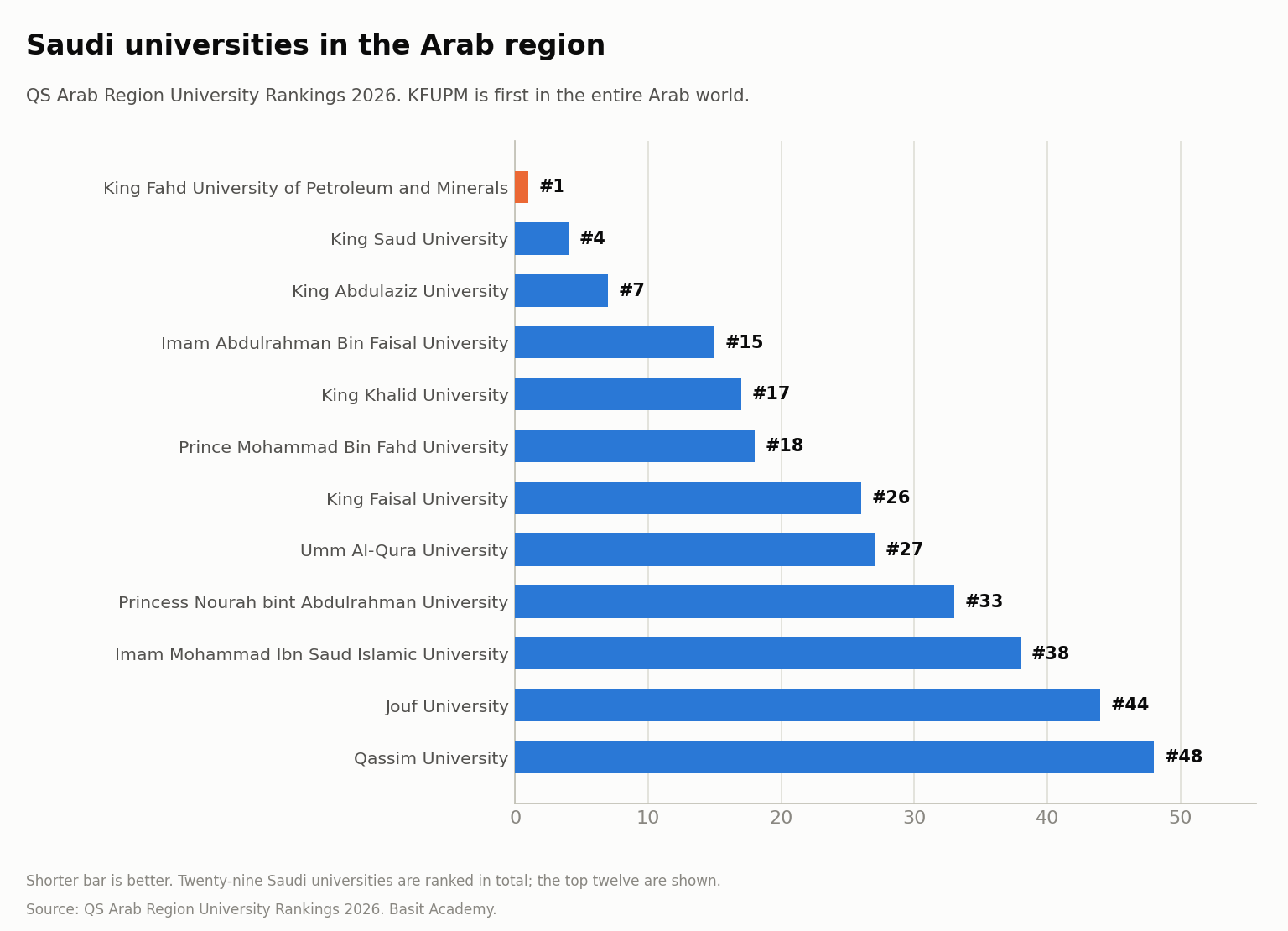
Twenty-nine Saudi universities are ranked in the QS Arab Region University Rankings 2026, and twenty-four of them sit in the Arab top 100. Three are in the regional top ten.
KFUPM at number one is the headline, and it is worth pausing on: out of 298 universities across twenty Arab countries, the top one is Saudi.
Vision 2030 and the Top-200 Target
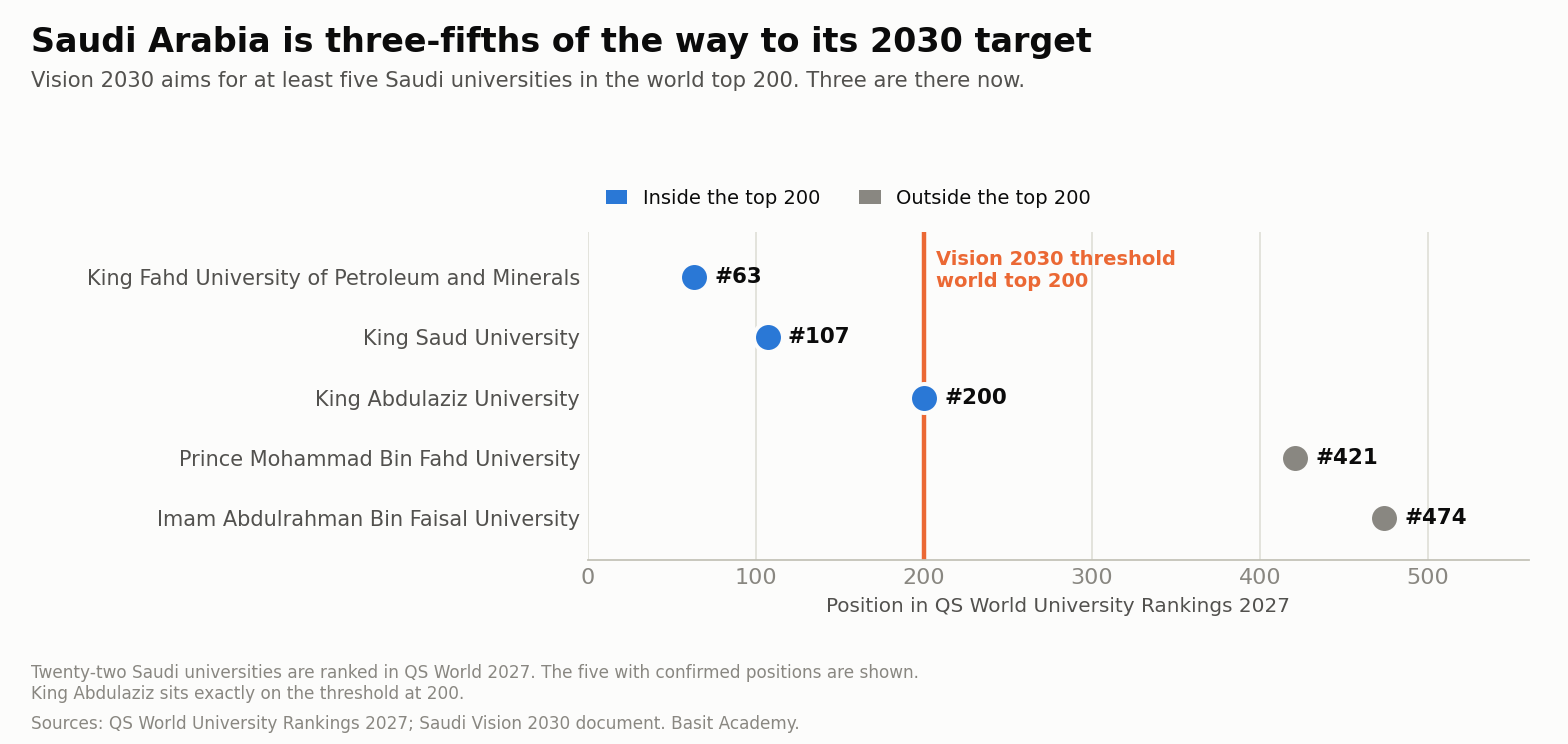
The Vision 2030 document sets a specific, checkable goal: “we aim to have at least five Saudi universities among the top 200 universities in international rankings.”
As of the QS World University Rankings 2027, published in June 2026, three are there — KFUPM at 63, King Saud at 107, and King Abdulaziz exactly on the line at 200. Twenty-two Saudi universities are ranked in total.
Three out of five with four years to go. That is the context every one of these business schools is operating in, and it explains the pace of new accreditations.
What an MBA Costs in Saudi Arabia
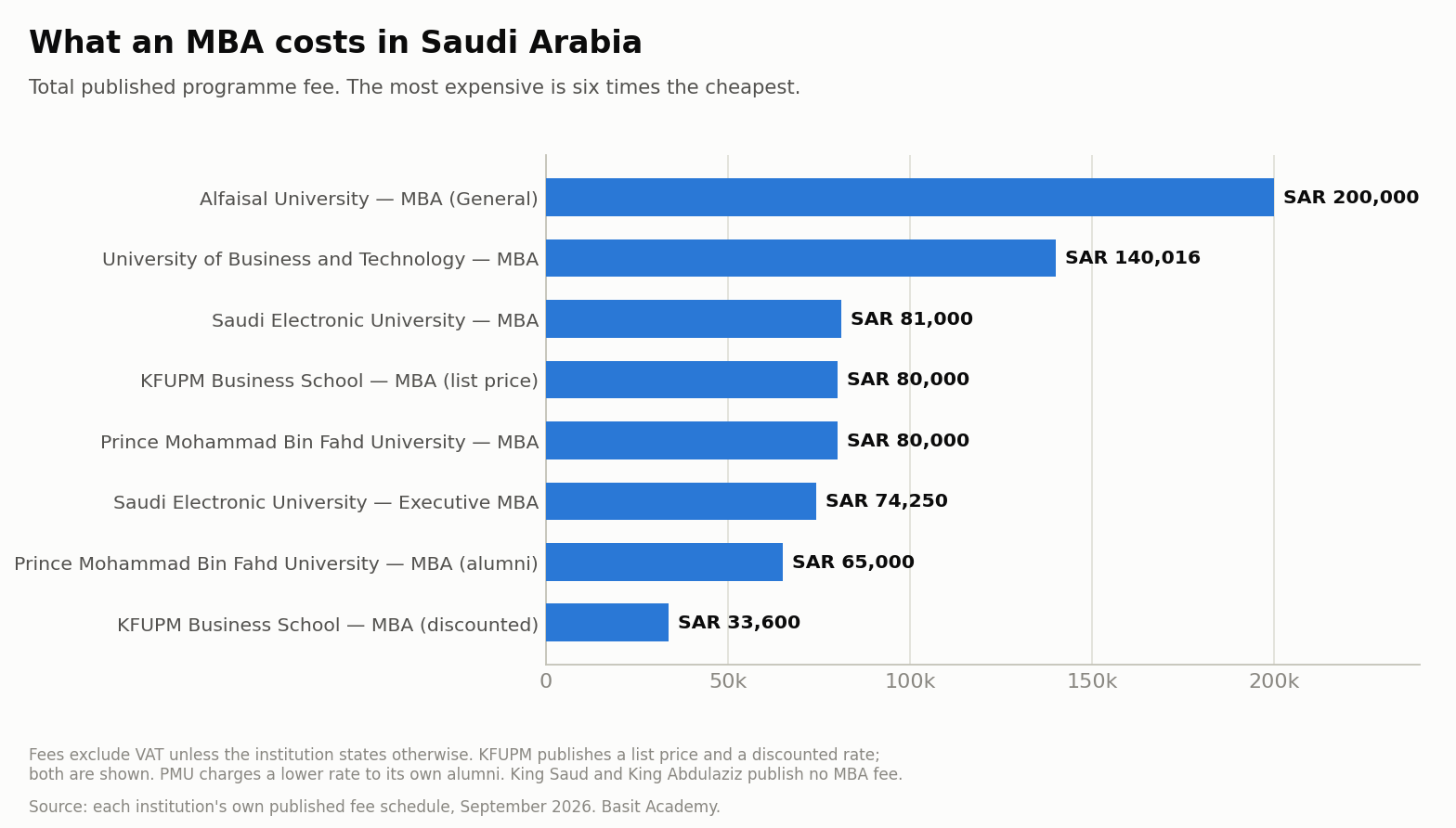
The spread is six-fold, and it does not track quality in the way you might expect.
| Institution | Programme | Total fee | Credit hours | Format |
| Alfaisal University | MBA (General) | SAR 200,000 | Not published | Evening, 2 years |
| University of Business and Technology | MBA | SAR 140,016 | 48 | Not published |
| Saudi Electronic University | MBA | SAR 81,000 | 36 | Blended, 4 semesters |
| KFUPM Business School | MBA — list price | SAR 80,000 | 36 | Part-time evening, 2 years |
| Prince Mohammad Bin Fahd University | MBA | SAR 80,000 | 36 | Not published |
| Saudi Electronic University | Executive MBA | SAR 74,250 | 33 | Not published |
| Prince Mohammad Bin Fahd University | MBA — PMU alumni | SAR 65,000 | 36 | Not published |
| KFUPM Business School | MBA — discounted rate | SAR 33,600 | 36 | Part-time evening, 2 years |
| Prince Sultan University | MBA (4 tracks) | SAR 5,000 per credit hour | Not published | Not published |
| King Saud University | MBA | Not published | 48 | 5–10 semesters |
| King Abdulaziz University | MBA | Not published | Not published | 2 years |
Four things worth taking from that table.
- The best-accredited MBA is among the cheapest. KFUPM holds the only AMBA accreditation in the country and its discounted rate is the lowest fee on this page. Price is not signalling quality here.
- Ask about the discount. KFUPM publishes both a list price and a rate “as low as” SAR 33,600. That is a 58% difference and it is not automatic — find out what qualifies you.
- Alumni rates are real money. PMU charges its own graduates SAR 15,000 less. If you did your bachelor’s in Saudi Arabia, ask every school on this list whether it does the same.
VAT is not always included. PMU adds 15% for non-Saudi students. SEU’s fees are published excluding VAT. On an SAR 81,000 programme that is another SAR 12,150.
Get Help With Your MBA Assignments — 24/7
Studying Online: Saudi Electronic University
SEU deserves its own section, because it solves a problem none of the campus schools do.
SEU is a government university delivering blended learning — part on campus, part at a distance — which makes it the realistic option for anyone already working full time or living away from Riyadh, Jeddah or Dhahran.
| Item | Detail |
| MBA fee | SAR 81,000 — 36 credit hours at SAR 2,250, excluding VAT |
| Executive MBA fee | SAR 74,250 — 33 credit hours at the same rate |
| Preparatory semester | Optional, SAR 9,000 for 12 hours |
| Duration | Four semesters, two years |
| Language | English only |
| Delivery | Blended — on campus and distance |
SEU is not AACSB-accredited, and this page is not going to pretend otherwise. What it offers instead is a government-accredited English-language MBA you can complete while employed, at a fee in the middle of the range. For a large share of working Saudi professionals that combination is the deciding factor.
One practical note: the whole programme is assessed through critical thinking assignments, discussion boards and a final research project, and it is taught entirely in English. Students who have been away from academic study for a few years usually find the writing harder than the business content.
The Wider Picture
Saudi Arabia has around 1.57 million students in higher education and a post-secondary enrolment rate of 83.88%. There are 29 government universities and 38 private universities and colleges.
Business, administration and law is the largest single field of study in the country, producing 119,854 graduates in 2023 — up from 94,909 the year before.
And the gender picture has shifted completely. The gender parity index in Saudi higher education reached 1.01 in 2024, meaning slightly more women than men. In 2006 the gap was twenty percentage points. At SEU specifically, female enrolment nearly doubled between 2018 and 2024.
How to Choose
- Check the accreditation yourself. Search the school on the AACSB, EFMD and AMBA directories rather than trusting a logo in a prospectus. It takes two minutes.
- Separate school accreditation from programme accreditation. AACSB assesses the school. AMBA assesses the MBA. Only KFUPM has both.
- Ask for the total fee, including VAT and any alumni discount. Per-credit-hour pricing is not a total, and two schools on this page publish only the per-hour rate.
- Check the teaching times before anything else. Most of these MBAs are built for working professionals, but evening-only and weekend-only are very different commitments.
- Confirm the language. These programmes are taught in English. If your degree was in Arabic, budget time for the academic writing, not just the subject.
- Ask what happens if you need a semester out. KSU allows up to ten semesters. Others are less flexible.
Studying Business in Saudi Arabia? We Can Help
Whichever school you choose, the coursework looks similar: assignments that want an argument rather than a summary, discussion boards that want engagement rather than agreement, and referencing that has to be right.
Basit Academy works with MBA and postgraduate students across Saudi Arabia, with particular depth on the SEU programmes. Qualified tutors, human written, never AI.