Two weeks ago, Saudi Arabia got its first foreign university campus.
The University of New Haven welcomed students to Misk City in Riyadh on 23 August 2026, three years after the Kingdom wrote the rules that made it possible. It is the first and, at the time of writing, the only operating foreign branch campus in Saudi Arabia.
That single opening changes the map of foreign universities in the Gulf. This guide covers every campus that is actually operating, what each one costs, which ones have closed, and how to tell a real branch campus from a partnership that only sounds like one.
Studying in the Gulf? Get Assignment Help From Qualified Tutors
What Counts as a “Foreign University” in the Gulf?
Most lists of foreign universities in the Middle East are wrong, and they are wrong for one reason: they do not define the term before they start counting.
There are three different things that get lumped together, and the difference matters enormously to your degree certificate.
| Type | What it means | Whose name is on your degree |
| International branch campus | A foreign university owns and operates a campus in the Gulf, in its own name, teaching its own degree | The foreign university. A Georgetown degree from Doha is a Georgetown degree |
| Validated or franchised programme | A locally owned university teaches a foreign university’s curriculum, and the foreign partner awards the degree | The foreign partner, but you did not attend that university |
| Affiliated or advised institution | A local university takes curriculum, quality assurance or advisory input from a foreign partner | The local university. The foreign name is a partner, not an awarding body |
This guide uses the standard research definition of a branch campus: the campus is owned at least in part by the foreign provider, operates in that provider’s name, and delivers a full degree on site that the foreign provider awards.
That distinction is not academic pedantry. Employers and postgraduate admissions offices ask which institution awarded your degree. If you are choosing a university partly for the name on the certificate, you need to know which of the three you are looking at before you pay a deposit.
Foreign University Campuses in the Gulf: The 2026 Count
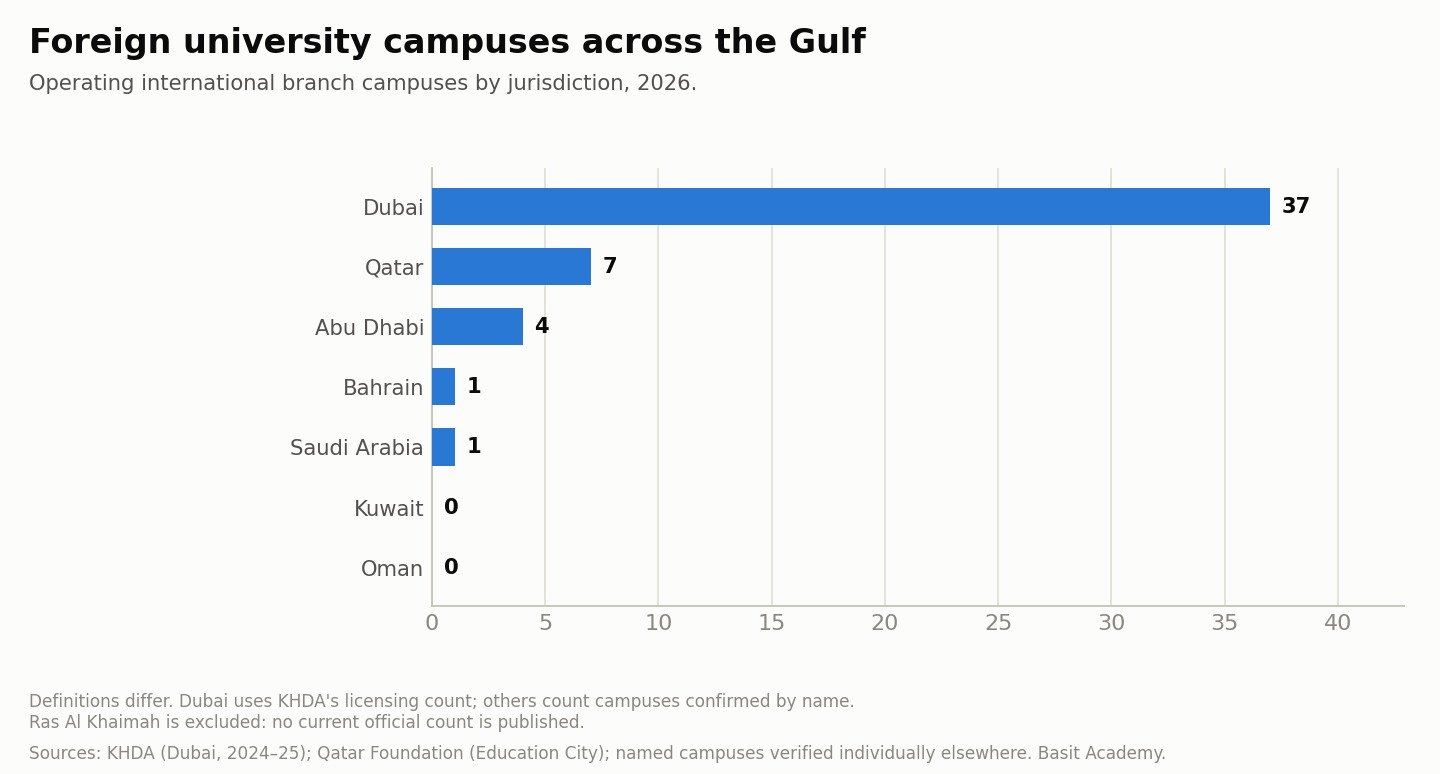
Dubai is not the leader in this market. It is the market.
KHDA, the Dubai regulator, licensed 41 private higher education providers in 2024–25, of which 37 operate as international branch campuses representing twelve countries. Qatar’s Education City has seven foreign partner universities. Everywhere else in the Gulf is in single figures.
Bahrain and Saudi Arabia have one apiece. Kuwait and Oman have none — not because they have no foreign involvement in higher education, but because their models are built on partnership rather than ownership. More on that below, because it is the most misunderstood part of the whole picture.
One caution on the numbers. Each jurisdiction counts differently. KHDA counts by its own licensing category; the Cross-Border Education Research Team, which uses a stricter test, counts 22 for the entire UAE. Both are defensible. Any article that gives you a single Gulf-wide total without saying which definition it used is guessing.
How the Gulf Built Its Campuses: Three Decades in One Chart
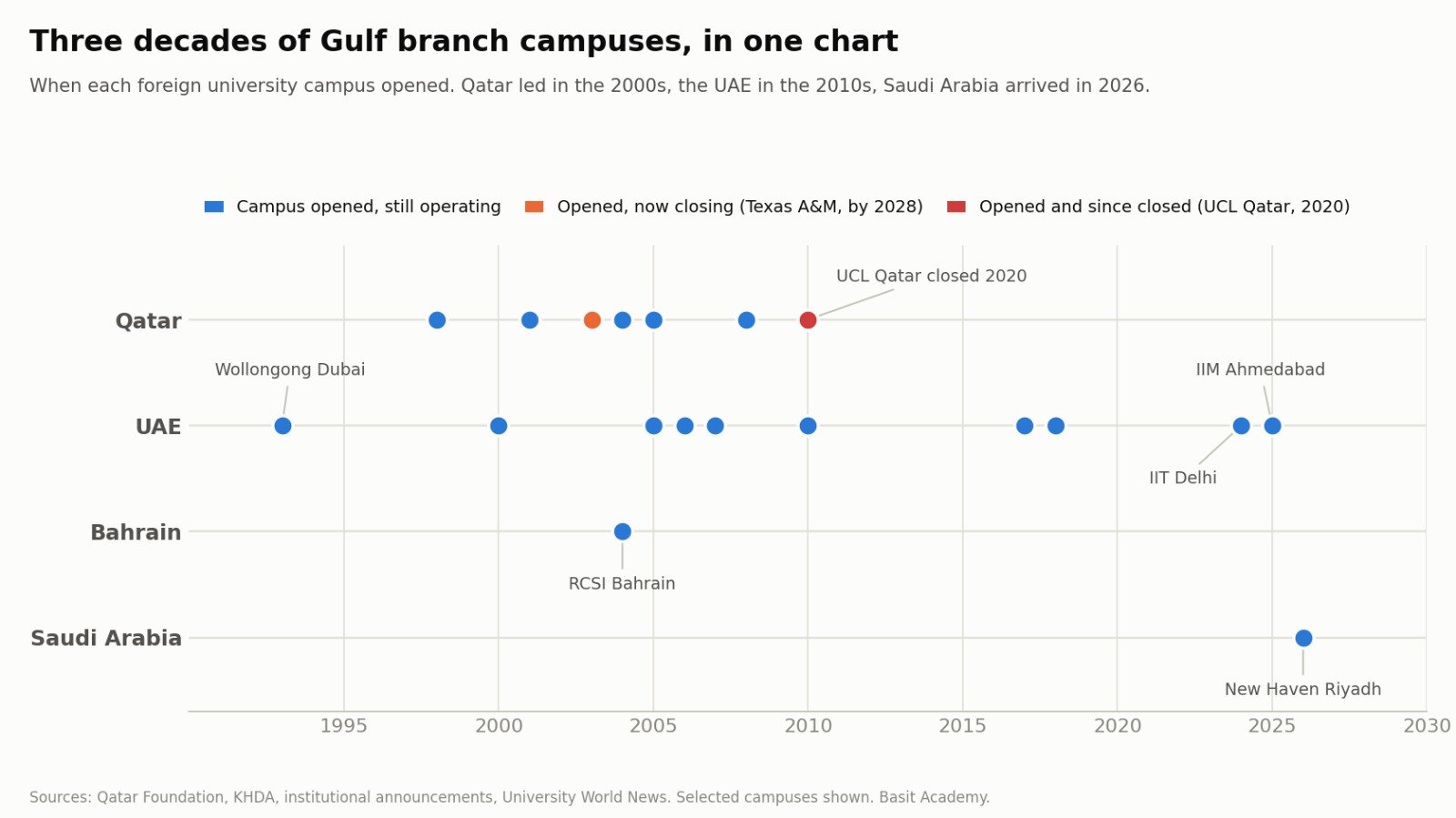
The pattern is a relay, and each leg lasted about a decade.
Qatar ran first. Virginia Commonwealth arrived in 1998, Weill Cornell in 2001, and by 2010 Education City had eight universities on one site. Qatar Foundation paid for the buildings and invited the universities in — a model no one had tried at that scale.
The UAE ran second. Wollongong had been in Dubai since 1993, but the acceleration came with the free zones. Dubai International Academic City and Dubai Knowledge Park turned campus-opening into a licensing process, and the count went from a handful to 37.
Saudi Arabia is running now. The Kingdom approved its Executive Regulation for foreign university branches in October 2023, granted its first Council of Ministers approval in October 2025, and opened its first campus in August 2026.
The chart also shows the part these lists usually leave out: campuses close. University College London opened in Doha in 2010 and closed in 2020. Texas A&M, in Qatar since 2003, is in a managed shutdown that completes in 2028.
Saudi Arabia: The First Foreign Campus Just Opened
This is the most important development in Gulf higher education this decade, and it is very new.
| Item | Detail |
| University | University of New Haven (Connecticut, USA) |
| Campus | Misk City, Riyadh |
| Opened | 23 August 2026 |
| Approval | Saudi Council of Ministers, 8 October 2025 — the first branch campus approval granted |
| Accreditation | NECHE, the same US accreditation the university holds for its domestic programmes |
| First programmes | College of Business and Digital Innovation — business management, marketing, sport management, esports, plus an MBA |
| Reported demand | Over 4,000 expressions of interest and 250 formal applications by May 2026 |
| Long-term target | Around 13,000 students within ten years |
Why it took three years
Saudi Arabia approved the legal framework — the Executive Regulation for establishing branches of foreign universities — in October 2023. Five international universities were named in August 2024 as having received licences, and this is where almost every article on the subject goes wrong.
The five universities named in 2024 received Ministry of Investment licences, not branch campus approvals. They are different permissions from different ministries. That distinction is why New Haven, which was not among the five, could accurately claim to be first.
Two years on, the five have gone in different directions.
| University | Announced 2024 | Status, September 2026 |
| University of Strathclyde (UK) | Riyadh campus | Approved by the Saudi Cabinet in October 2025. Not yet open |
| University of Wollongong (Australia) | Riyadh campus | Delayed. Its Saudi site still says “pending regulatory approval” |
| Arizona State University (USA) | Riyadh campus | Pivoted. Now a dual-degree partnership with Kingdom University, Riyadh, from September 2026. Not a branch campus |
| IE University (Spain) | Saudi presence | Pivoted. Opened a leadership and innovation centre in Riyadh. Explicitly not degree-granting |
| RCSI (Ireland) | Saudi presence | An operations office, launched November 2024. Postgraduate training and consultancy, not a degree campus |
Heriot-Watt is the newest name in the queue, with a head of terms signed in October 2025 for a Saudi campus, subject to approvals.
The demand behind all of this
Saudi Arabia has around 1.57 million students in higher education, and roughly 200,000 school leavers a year who do not get a university place.
That gap is the entire commercial case for foreign campuses in the Kingdom, and it is why the queue keeps growing even though the approvals are slow.
Studying at a Saudi University? Talk to a Tutor
Qatar: Education City and the Seven
Qatar built the model everyone else copied. Eight universities on one campus in Doha, seven of them foreign, all funded into existence by Qatar Foundation.
| University | Home country | Opened | What it teaches |
| VCUarts Qatar | USA | 1998 | Fashion, graphic and interior design, painting, art history |
| Weill Cornell Medicine – Qatar | USA | 2001 | Six-year MD, awarding a Cornell degree |
| Texas A&M University at Qatar | USA | 2003 | Chemical, electrical, mechanical and petroleum engineering — closing by 2028 |
| Carnegie Mellon University in Qatar | USA | 2004 | Computer science, business administration, information systems, biological sciences |
| Georgetown University in Qatar | USA | 2005 | International politics, economics, culture and politics, history |
| Northwestern University in Qatar | USA | 2008 | Journalism, strategic communication, communication |
| HEC Paris in Qatar | France | 2010 | Executive MBA and executive education |
| Hamad Bin Khalifa University | Qatar | 2010 | Qatari, not foreign — included because it now absorbs Texas A&M’s engineering programmes |
The Texas A&M closure, explained properly
In February 2024 the Texas A&M System Board of Regents voted to close the Qatar campus. The wind-down runs to 2028: Hamad Bin Khalifa University took over undergraduate engineering admissions from 2024–25, the final graduate cohort was admitted in autumn 2024, and research activity ends in December 2027.
At the time of the announcement the campus had 844 students. If you are looking at engineering in Doha, you are now looking at an HBKU degree, not a Texas A&M one.
University College London’s Qatar campus opened in 2010 and closed in 2020. Two of Education City’s original foreign universities are therefore gone or going, which is worth knowing before you assume a branch campus is permanent.
The UAE: Where Most of the Gulf’s Campuses Actually Are
Thirty-seven branch campuses in Dubai alone, plus four in Abu Dhabi and a cluster in Ras Al Khaimah. Here are the ones with a verified campus and an opening date.
Dubai
| University | Home country | Dubai campus opened |
| University of Wollongong in Dubai | Australia | 1993 — the first Australian university in the UAE |
| BITS Pilani Dubai | India | 2000 — the first offshore campus of any Indian institution |
| Manipal Academy of Higher Education Dubai | India | 2000 |
| SP Jain School of Global Management | Australia (Indian origin) | 2004 |
| Heriot-Watt University Dubai | UK | 2005 — around 5,000 students, 115 nationalities |
| Institute of Management Technology Dubai | India | 2006 |
| ESMOD Dubai | France | 2006 — fashion |
| London Business School Dubai | UK | 2007 — LBS’s first campus outside London |
| Hult International Business School Dubai | USA/UK | 2008 |
| Amity University Dubai | India | 2011 |
| Curtin University Dubai | Australia | 2017 |
| University of Birmingham Dubai | UK | 2018 |
| De Montfort University Dubai | UK | 2021 — DMU’s first international campus |
| Symbiosis International University Dubai | India | 2024 |
| IIM Ahmedabad Dubai | India | 2025 — IIMA’s first international campus, one-year MBA |
| Middlesex University Dubai | UK | Operating; opening year not published |
| Murdoch University Dubai | Australia | Operating; opening year not published |
Three names appear on other lists and should not. The University of Bradford runs a regional hub in Dubai Knowledge Park delivering an Executive MBA, not a campus. The University of Manchester operates a Middle East Centre for part-time and executive programmes, not a campus. Neither is a branch campus, and both are routinely miscounted.
Abu Dhabi
| University | Home country | Opened | Notes |
| Sorbonne University Abu Dhabi | France | 2006 | Degrees awarded by Sorbonne Université and Université Paris Cité. 3,000+ students |
| INSEAD Middle East | France/Singapore | 2007 | Executive MBA and executive education. Current Al Maryah Island campus opened 2017 |
| NYU Abu Dhabi | USA | 2010 | A full degree-granting portal campus of NYU. Around 2,075 undergraduates |
| IIT Delhi Abu Dhabi | India | 2024 | IIT Delhi’s first international campus. BTech in energy engineering and computer science |
Ras Al Khaimah
Ras Al Khaimah has its own academic free zone. The University of West London opened its first overseas branch campus there in 2017, and Jaipur National University runs an RAK campus. The University of Greater Manchester — the institution formerly called the University of Bolton — has run a licensed academic centre in RAK since 2008, which is not the same thing as a campus.
No current official count is published for Ras Al Khaimah, which is why it does not appear in the chart above.
What a Foreign University Degree Costs in the Gulf
This is the number most guides skip, and it is the one that decides where people actually apply.
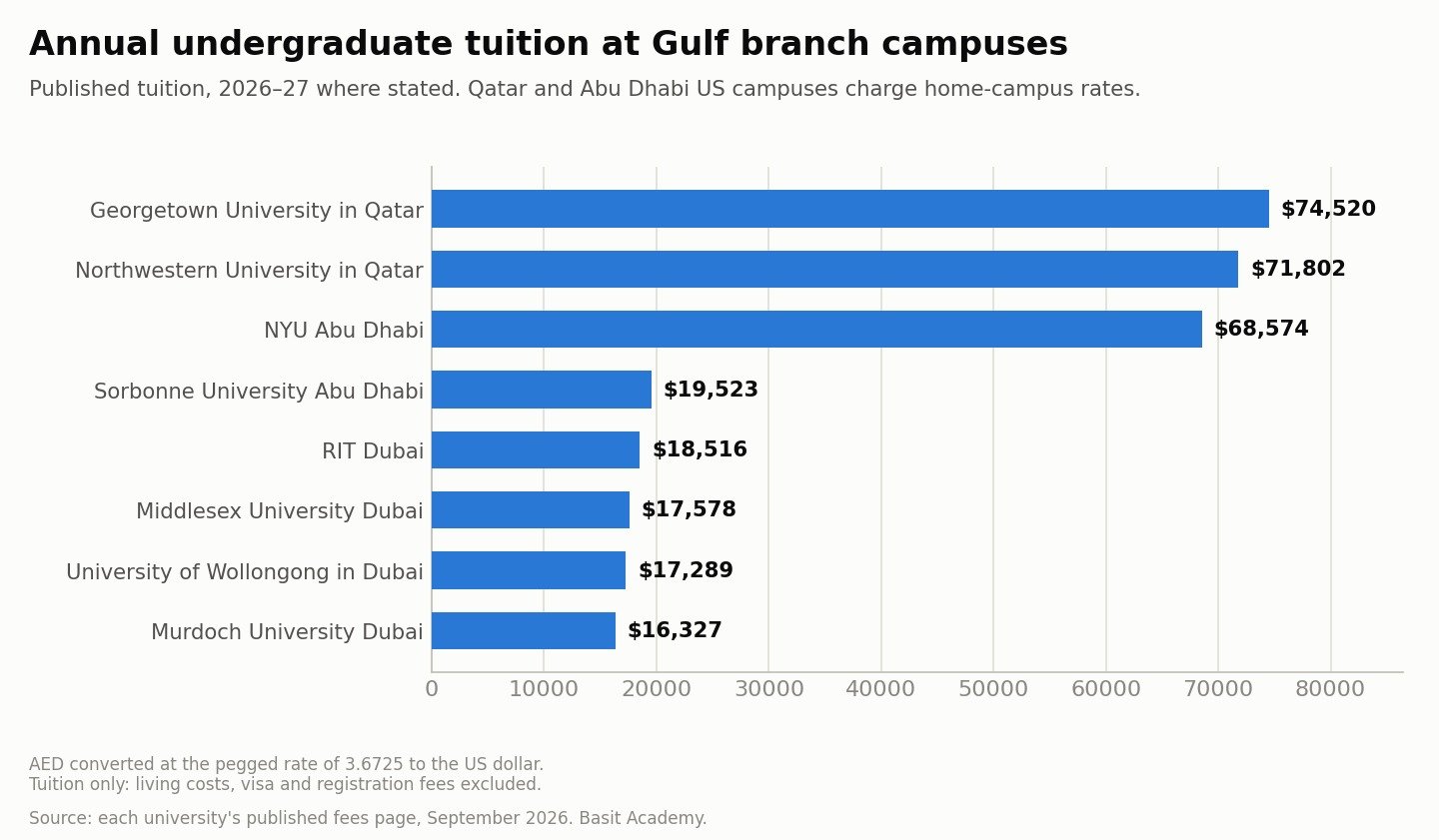
The gap is not a few thousand dollars. It is a factor of four.
The American universities in Qatar’s Education City and NYU Abu Dhabi charge their home-campus US rates. Georgetown says explicitly that students in Doha “are assessed the same tuition charges as their counterparts studying in Washington, DC”. Northwestern says the same. That puts a Doha degree at around 70,000 US dollars a year in tuition alone.
Dubai’s branch campuses sit at roughly 16,000 to 19,000 US dollars a year — a quarter of the price, for a degree awarded by the same kind of foreign parent institution.
| University | Annual undergraduate tuition | Academic year |
| Georgetown University in Qatar | USD 74,520 (QAR 271,998) | 2026–27 |
| Northwestern University in Qatar | USD 71,802 | 2026–27 |
| NYU Abu Dhabi | USD 68,574 tuition; USD 90,442 total cost of attendance | 2026–27 |
| Sorbonne University Abu Dhabi | AED 71,700 (about USD 19,523) | Not stated |
| RIT Dubai | AED 68,000 (USD 18,516) | Current, set Fall 2023 |
| Middlesex University Dubai | AED 64,557 (about USD 17,578) | 2026–27 |
| University of Wollongong in Dubai | AED 63,449 (USD 17,289) | Current |
| Murdoch University Dubai | AED 59,960 (about USD 16,327) | 2026 intake |
Two universities do not publish a single figure. Heriot-Watt Dubai and the University of Birmingham Dubai both price per programme rather than per year, so their tuition appears only inside individual course pages. Birmingham does publish that it holds your first-year fee flat for the duration of the course and offers scholarships up to 30%.
What the headline price does not tell you
Qatar Foundation runs a common financial aid system across Education City even though tuition is not common. Aid comes as interest-free need-based loans, not grants, and they can be repaid either on a standard schedule or by working for one of hundreds of approved organisations in Qatar. Qatar Foundation states that admission is need-blind.
So the 74,000-dollar sticker price at Georgetown Qatar is not what most students pay. It is also not a grant. It is a loan with a service-based repayment route attached, and that is a materially different proposition from a discount.
NYU Abu Dhabi awards financial aid based on demonstrated need. Its site no longer carries the explicit need-blind wording it used before 2021, so if that matters to your decision, ask the admissions office directly rather than relying on a third-party article — including this one.
Get Help With Your University Assignments — 24/7
Who Studies at These Campuses, and What They Study
Dubai publishes the best data in the region, so this section uses it. KHDA’s 2024–25 figures cover 42,026 students across 41 institutions and 706 programmes.
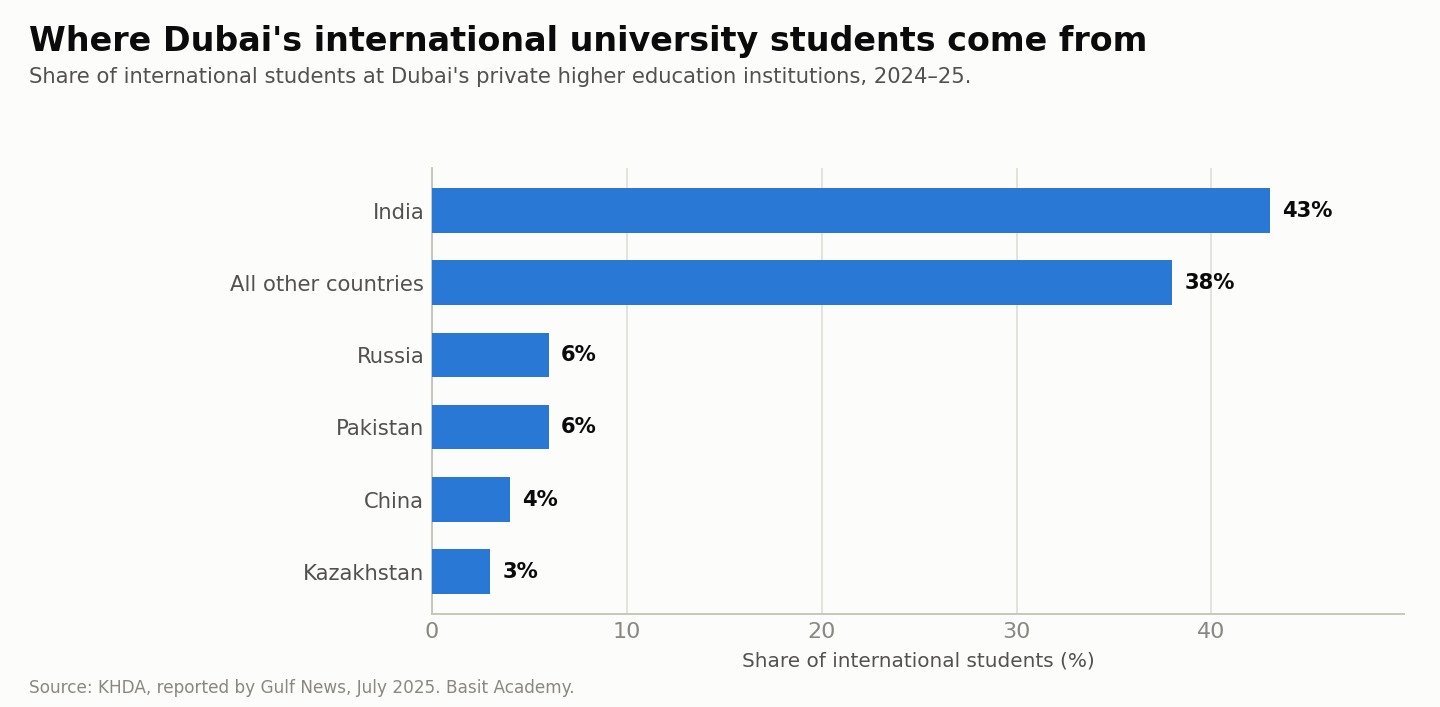
India supplies 43% of Dubai’s international students — more than every other country combined among the named top five. Russia and Pakistan follow at 6% each, then China at 4% and Kazakhstan at 3%.
International students now make up 35% of enrolment at Dubai’s private higher education institutions, up 29% in a single year. Dubai’s stated target is 50% by 2033.
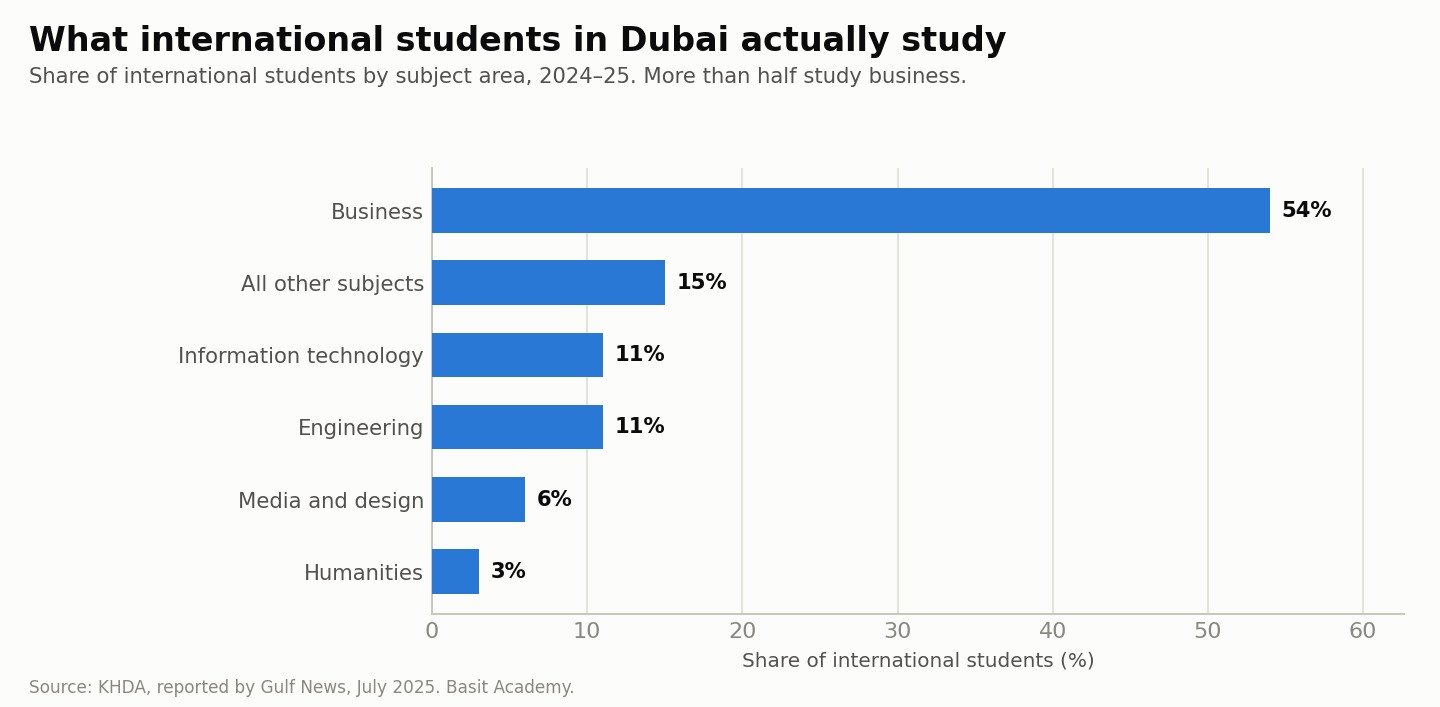
More than half of all international students in Dubai study business. Information technology and engineering take 11% each.
That concentration explains something about the Gulf branch campus market generally: the campuses that have opened are overwhelmingly business, engineering and IT campuses, because that is where the demand and the fee income are. If you want to study humanities at a foreign campus in the Gulf, your options are genuinely narrow.
| Dubai higher education, 2024–25 | Figure |
| Total students | 42,026 — a record |
| Private higher education providers | 41 |
| Of which international branch campuses | 37, representing 12 countries |
| Programmes offered | 706 |
| Faculty | 2,123 |
| Growth in total enrolment | 20% year on year |
| Growth in international students | 29% year on year |
| Growth in Emirati students | 22% year on year |
| Forecast | Over 40% enrolment growth by 2029–30 |
Kuwait and Oman: Why the Count Is Zero
Kuwait and Oman appear as zero in the chart, and that number needs explaining, because both countries have universities with prominent foreign names.
Kuwait’s regulator requires it. The Private Universities Council mandates that every private institution operate in collaboration with a reputable foreign partner. The result is a sector full of institutions that look like branch campuses and are not.
| Institution | Foreign partner | What the partnership actually is |
| American University of Kuwait | Dartmouth College | Advisory and consultative only. AUK states plainly that it is “an independent Kuwaiti institution, not a branch campus of Dartmouth”. Dartmouth awards no degrees |
| American University of the Middle East | Purdue University | Academic partnership. AUM awards its own degrees |
| Gulf University for Science and Technology | University of Missouri–St. Louis | Dual-enrolment agreement |
| Arab Open University | UK Open University | Validation — the OU validates the degrees |
Oman follows the same pattern. The German University of Technology in Oman is owned by an Omani company, accredited by Oman’s quality authority, and affiliated with RWTH Aachen, which contributes curriculum and sits on the board. Majan University College has been affiliated with the University of Bedfordshire since 1998, and most of its degrees are awarded by Bedfordshire. Middle East College is affiliated with Coventry.
None of these is a branch campus. Several are excellent institutions. The point is that the foreign name on the building tells you almost nothing about who awards your degree — you have to check.
Bahrain is the interesting middle case. RCSI Medical University of Bahrain, open since 2004 with more than 1,300 students, is simultaneously a constituent university of RCSI Ireland and licensed by Bahrain as an independent private university. Medical graduates receive their degree from both the National University of Ireland and RCSI Bahrain. It is best described as a dual-licensed constituent campus rather than flatly a branch campus.
Campuses That Closed: The Part Other Lists Leave Out
A branch campus is a business, and businesses close. Before you commit three or four years to one, it is worth knowing how often it happens in this region.
| Campus | Home country | Closed | What happened |
| George Mason University Ras Al Khaimah | USA | 2009 | 120 students against a 2,000 target. The local funder cut its subsidy by about half |
| Michigan State University Dubai | USA | 2010 | All five undergraduate programmes terminated. Over 100 students affected |
| University of Waterloo Dubai | Canada | 2012 | 140 students against a break-even of around 500 |
| UCL Qatar | UK | 2020 | Closed after a decade in Education City |
| MODUL University Dubai | Austria | 2020 | Licence revoked by the UAE Ministry of Education, four years after opening |
| Harrisburg University Dubai | USA | 2024 | Closed roughly a year after opening, when investors withdrew amid the parent institution’s financial difficulties |
| Texas A&M University at Qatar | USA | By 2028 | Managed wind-down. HBKU has taken over the engineering programmes |
The pattern in almost every case is the same: enrolment came in far below plan, and the local funder or the home institution stopped absorbing the loss.
Five things to check before you enrol
- Who awards the degree? Get it in writing. This is the single most important question and the one most prospectuses answer vaguely.
- Is the campus accredited in the home country as well as locally? New Haven Riyadh holds NECHE accreditation, the same as its Connecticut campus. Not every campus can say that.
- How many students are actually enrolled? A campus well below its target is a campus under pressure.
- What is the teach-out commitment? If the campus closes mid-degree, what happens to you? Texas A&M Qatar is teaching out its remaining students; Harrisburg Dubai closed inside a year.
- Is the local regulator active? KHDA in Dubai publishes ratings. Saudi Arabia’s framework is new and its approvals have been slow, which cuts both ways: slow to open, but heavily vetted.
Studying in the Gulf? We Can Help
Whichever campus you choose, the coursework is the same shape: assignments that want an argument rather than a summary, discussion boards that want engagement rather than agreement, and referencing that has to be right.
Basit Academy works with students across Saudi Arabia and the Gulf. Qualified tutors, human written, never AI.